Assignment 1: Mindmap
Designing a Mindmap
Mindmap
A Mind Map is a diagram for representing tasks, words, concepts, or items linked to and arranged around a central concept or subject using a non-linear graphical layout that allows the user to build an intuitive framework around a central concept (https://www.mindmapping.com/mind-map).
Objective: the objective of this week's task is to use transmodalization to create other semiotic spaces for the representation of meanings that allow a better appropriation of the contents of the readings.
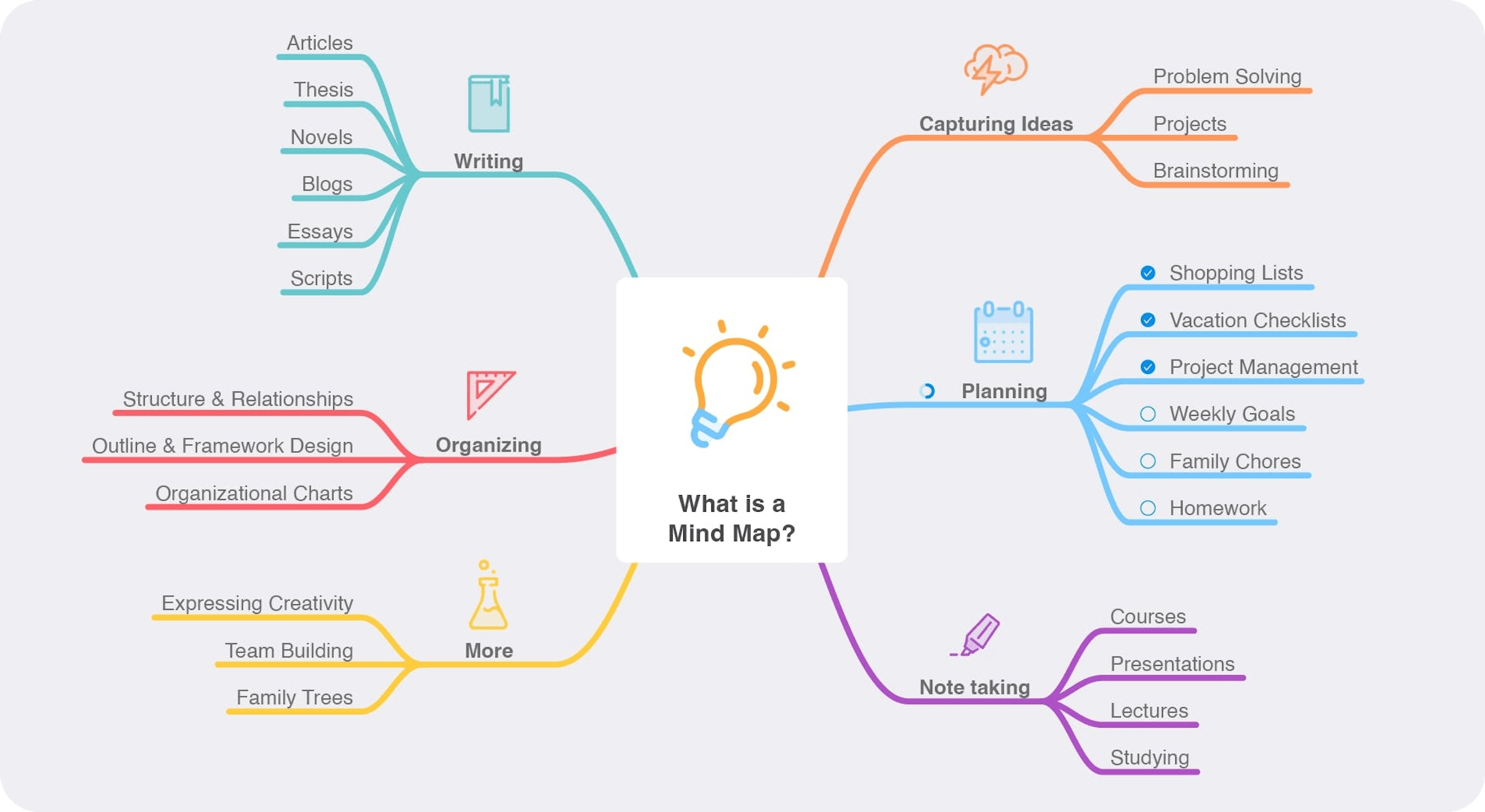
Please, design a mindmap to represent the meanings you make out of the reading “Postcolonial and Decolonial reconstructions...” by Bhambra (2014). Since Mignolo’s ideas are reviewed in the reading, use the following reading by the author to extend the presentation of his ideas.
Instruction:
1. Read the material assigned for the week.
2. Visit mindmeister and open an account. You will need your Google email address.
3. Design the mindmap of the assigned reading.
4. Once finished, click publish and then copy the link to publish it in our blog.
5. After publishing your mindmap, write a commentary below on our blog answering the question: After these initial readings, do you feel that the colonial matrix of power manifests in any way in your workplace, your own teaching or personal life? In what ways does it do it? The post should be between 300 to 500 words.
6. Finally, after making your post, visit two or your classmates’ blogs and analyze their publications and react discussing the ability to synthesize the main ideas, the clarity of the diagram, and whether you agree or not with the way h/he has answered the prompt.
Grading scheme:
● Quality in visual design: color, geometric shapes, spatial organization (0.5 points).
● Quality of the diagram in terms of conceptual appropriation of the texts read (2 points).
● Punctuality in the publication (0.5 points)
● Comment to two peers of at least 200 words (2 points)
● Make the post before noon on Friday Feb. 21st so that your classmates can react to it by Monday 24th midnight.
Please, let me know if you have any questions or difficulties.
José Aldemar
This comment has been removed by the author.
ReplyDeleteJhonny, I really liked your mind map and how it connects to your reflection. Your selection of thinkers and concepts presents a clear comparison of postcolonial and decolonial perspectives. I like how your mind map shows how coloniality is not just about power but also about how knowledge is produced and whose perspectives are valued.
DeleteYour reflection expands on these ideas in a way that I feel is very realistic and relevant. The way you describe language policy in your university made me think about how English continues to dominate academic spaces, shaping not only what is taught but also what is seen as legitimate knowledge. Even when institutions promote inclusion, they often work within the same structures they claim to challenge. The same happens in my work context.
I also found your point about how students and faculty perceive academic legitimacy really interesting. The idea that Western traditions define what is considered valuable knowledge is something I have also noticed. Even students, who might benefit from alternative ways of learning, sometimes resist changes that challenge traditional classroom hierarchies. The expectation that the teacher is the ultimate authority is something that is difficult to undo, even when we try to create more collaborative learning spaces.
Jhonny Segura Antury
ReplyDeleteMindmap
https://mm.tt/app/map/3627935784?t=V6M4ql1s2v
Based on some of the highlights of Bhambra and Mignolo, I want to comment on how the colonial matrix of power is present in my workplace and teaching practices. Undoubtedly, there are power structures that shape knowledge production and teaching and learning practices at the university where I work. Although subtle, the effects are evident in the university's administrative and academic dynamics.
In my university, as in most public and private universities, the dominance of Western epistemologies in the curriculum design and stakeholders’ academic expectations is evident. Although the institution strives for inclusion and interculturality, Western epistemologies, theories, and methodologies are pillars in constructing the “other” and legitimate knowledge. These pillars constitute strong structures that will neutralize any decolonial framework, which, to be honest, is not on the radar at any administrative or academic level at the university. I would like to explain some of those pillars quickly:
- Language policy: English remains the primary medium of instruction in academia because of the dominant position of English within the academic programs and internationalization policy. External and internal stakeholders value English because of its international recognition and career benefits, which is also part of the discourse reproduction at the university. The university has other languages but is primarily European.
- Students and faculty perspectives of what is academic and credible: Mognolo expresses that the idea of modernity and intellectual legitimacy is strongly linked to Western traditions. Research, curriculum design, and extracurricular activities constantly reinforce a professional profile that responds to market and societal needs and prioritizes the narrative of progress.
- Colonial hierarchies of authority still mediate classroom interactions. The teaching model still emphasizes the teacher-centered approach. The university has been trying to develop an “Active learning” model that seeks to foster dialogical methods. Still, the Western scholarship logic rooted in the practices makes exploring other ways of interaction challenging. An example of this is students complaining when teachers do not have lectures in their classes, and they propose a more collaborative and student-centered approach. Students demand that the teacher explain and clarify the topic since they consider them legitimate knowledge authority.
The previous link is not working. Please check this one. https://www.mindmeister.com/3627935784/postcolonial-and-dicolonial-dialogues
DeleteHi Jhonny,
DeleteNice mindmap! I like how you focused on the different authors cited by Bhambra and their ideas in a concise and precise way. I think the mindmap synthesizes clearly the concepts related to Decoloniality and Postcolonialism because although these topics are related, they address different ideals and aim at specific beliefs. In the reconstruction that Bhambra proposes, she brings together all the authors who have contributed to the movement, I think you were able to mention each participation explicitly, bringing up only the most relevant aspects.
Regarding your comment on the blog, I think it’s very interesting what you mentioned about the colonial hierarchies of authority still mediating classroom interactions. I guess changing things in our context implies explaining certain things to students, but still, it does not mean they will start seeing things immediately differently. For example, a complaint we have had from students is that in the English classes they feel they (the students) “talk too much”, opposite to having the professor talking for most of the class. So, instead of thinking they are practicing or developing a skill, they expect the professor to lecture them for two hours.
Thank you for sharing your thoughts on the matter!
Dear Jhonny,
DeleteI think you did a nice job with your mind map and how you were able to organize the information based on the positions of different authors. Well done!!
Regarding your post, I fully agree with you on how influenced we are, at universities, by Western epistemologies. At the University where I work, there is also a huge influence on the teaching of English, French, German and Portuguese (European Languages) and there is a lot of advertisement for promoting them. Even though there have been some attempts to open some courses regarding indigenous languages, its information has not been properly advertised and consequently, some of them have not been offered due to the low number of students registered.
There was another aspect that called my attention in your post and that Carolina also highlighted. It is related to the teaching methodologies; to be honest, I haven’t thought about it from your perspectives, but I totally agree with you both; the teacher-centered approach and the amount of the teacher talk evidence a level of hierarchy and power that needs to be reconsidered.
Thank you for your post!
Dear Jhonny,
DeleteI enjoyed navigating your mindmap. It is easy to read and allows me to review the main representatives of postcolonial thought and decoloniality and their main ideas. It is odd though that Boaventura de Santos is not mentioned in Bhambra's review.
This is an interesting discussion that you start up and that is enriched by Carolina and Yuranny. The colonial matrix of power has acted in ways that shape an epistemic and ontological self in individuals that crystalizes in our ways to accept hierarchies and positionalities. For example, the idea that the person with the most knowledge (European, AngloSaxon) has authority and must be heard and respected: the teacher, While an indigenous Taita or mama won't have the same authority; Their knowledge does not have the same exchange value; it has been destituted. So, the students' idea that they are ontologically, aesthesically, socially and epistemologically inferior and thus that their classmates don't have the authority to participate in their learning and instead they require the authority of the teacher is a very clear example of how the CMP operates. This is why Mignolo insists that we need to start changing the terms of the conversation (the presuppositions, assumptions, and enunciations). For example, getting students to understand that their self, their local epistemologies are also valid represents a path to epistemic (of knowledge and ways of knowing) and ontological/aesthesic (being, sensing, and believing) reconstitution. This is a decolonial act on our part.
CAROLINA VALDIRI
ReplyDeleteLink to my mind map: https://mm.tt/app/map/3627894226?t=w4ooA2kiwz
I believe the colonial matrix of power manifests in various aspects of my life in different ways because we have all been educated under the Eurocentric worldview. First, at a professional level, it affects me because I am an English language teacher, and in some institutions, native speakers of the language have a higher status. Also, students tend to associate good quality with good pronunciation or years lived abroad. These beliefs demonstrate that in Colombia we have interiorized the idea that the Western views of the world are the right ones, and at the same time that the more we look like them, the better we become. Although I may disagree with them, I still need to demonstrate the quality of what I do constantly measured by the tenets of society.
Regarding my teaching practices, I realized I was trained to follow specific teaching methods that come from big international names, and for a very long time, I selected and used materials based on criteria that I now find colonizing. However, I think there are practices that are fine since they don’t cause any harm, but there are others, like not allowing Spanish in the classroom or not addressing social justice, that we should address to avoid perpetuating discrimination and injustice.
At an academic level, we discuss deeply critical interculturality in our PhD program. Still, when it comes to standards that we have to adhere to, we end up following the prescribed ways that the Western cultures have presented as valid. So if, for example, somebody suggests that the data collection methods we implement in our project should be decolonial and we agree to that, another person is going to tell us that if we don’t follow the standard collection data instruments, our study is going to lack validity or credibility, and in the end, we will go with what we call the “conventional” methods because we don’t want our projects to get rejected.
Additionally, I’m sure that there are many other ways in which the colonial matrix manifests in my life, but since we have naturalized certain behaviors and ways of thinking, I don’t get to question them and so I haven’t noticed them yet.
Hi Carolina,
DeleteI would like to address your comment about your teaching practices because I identify with this idea. I think we have been trying to adapt our teaching practices as a direct result of being part of the doctoral program. We are more critical with the materials, the content, and the methods we implement in our classes. In my case, sometimes when I am trying to implement something from a different perspective I feel uncertain about what I am doing and I think this is connected to what you mentioned about following specific methods and materials for a very long time. We are on our path to deinternalizing some practices.
Dear Carolina,
DeleteI enjoyed reading and analyzing your mind map; I liked the way you structured it and how you used key words to explain the most important parts of the reading.
There was something that really caught my attention and it was: “A change is needed”. I totally agree with that statement; the question that I have now is who is going to make that change? The answer is clear, each one of us in our corresponding contexts. The next question would be how? How can I do that? To be honest, I sometimes get discouraged by some colonial actions that happen at my context and despite of my efforts, I sometimes feel that “una golondrina no hace llover” (one swallow does not make a summer) and it worths nothing; however, I know I shouldn’t give up and continue with changes in my classes which are worthy. As my mom usually says: “de poquito en poquito, la gallinita llena el buche” (many a mickle makes a muckle). You made me reflect about it! Thanks for that!
p.s. As you could see, I am passionate about popular sayings 😊
Also, I think you mind map is visually appealing and I like the way you synthesized the main concepts of the reading.
DeleteJhonny Segura Antury.
DeleteHi Carolina, your mind map highlights the main threads about colonialism and postcolonialism discussed by Bhambra. The main themes and specific information provide a ramification that makes connections and ensures a flow in the presentation of the ideas.
Regarding your reflection on the colonial matrix, I believe the intersection you make between your personal, professional, and academic dimensions and the colonial matrix mirrors our experiences. We all faced native-speakerism at a stage in our professional lives; in my case, I started teaching in an institute where most of the teachers were native speakers. They embodied Western cultural ideals in language teaching and were legitimate English teachers for decision-makers and students. The non-native speakers were forced to demonstrate that we had pedagogical skills and native-like pronunciation to keep our jobs. I guess that was a burden for most of us.
Now, to step up pedagogically and didactically, we had to use all the available materials that were still influenced by the native-speakerism perspective. Materials that showed the speaker model’s traditions and behaviors for language learners to emulate. As a student, I still recall wanting to sound like a native speaker and adopting some dress codes and mannerisms. Nowadays, materials have tried to vary how English speakers are represented, of course, not as expected. Still, I want to point out that teachers are growing aware of the importance of adapting and creating more contextualized resources.
In the academic scenario, you have addressed an internal contradiction in the PhD, where some teachers have encouraged students to embrace the decolonial perspective. At the same time, academia demands that they stay faithful to academic standards. As part of the scholarly discussion, students must be free to adopt any relevant perspective to critically address their research problems. I guess that must be part of the natural argumentative spirit of academia.
From a critical perspective, your reflection invites us to analyze how we have followed trends that have impeded the recognition of the power matrix, which maintains certain relations that marginalize voices and practices.
Hi Carolina, thank you for your post. It caught my attention your thought process that you focused more on ideas rather than on the main representatives of the postcolonial and decolonial theories. I like the structure but surely it would be enriched by mentioning the actors that generated these new ways of thinking: Edward W. Said, Homi K. Bhabha and Gayatri C. Spivak and Mignolo, Lugones, Quijano.
DeleteI really appreciate your critical questions; we are immersed in a society where coloniality is structural in al dimensions of life including academia. You are all right; it is hard to navigate an academic space where multiple actors endowed with power such us your professors have a lot or little preference for the decolonial option. This is why it is an option. It is not a dogma. We all have to find our space in the decolonial spectrum. We need to dwell in the bordelines, generate border thinking and from there establish a dialogue with the traditional academic traditions. That is what we are trying to navigate in here. Besides as Jhonny said, it is the spirit of academia: diversity. The tricky part is that we need to sort of move within , across and around Western logics of knowledge production because a study judged by those within the matriz of power will be required to abide by the rationalist logics of a sound methods section with systematicity and evidence etc. Mignolo in his book on Decolonial Investigation does not seem to follow any of those principles. We have many challenges ahead of us!!
María Alejandra Villa Salazar
ReplyDeleteLink to my mind map
https://www.canva.com/design/DAGf4K06XMw/kv4lfCa3R02DOpX8D9EGRQ/view?utm_content=DAGf4K06XMw&utm_campaign=designshare&utm_medium=link2&utm_source=uniquelinks&utlId=h5e53468d54
As we have read the ideas of authors like Quijano, Spivak, Said and Lugano among others, let me to rethink how the colonial power has been presented in many aspects of mi life. If I talk as English student, I have to say that many times I felt not enough for speaking this language because some teacher said that I didn’t sound in the “correct way” it means as a native (British or American) speaker, it means the western knowledge has been seen as the total reality. Also, as woman, I have faced some imposition, I mean, some beauty canons have been naturalized, whereby women should straight their hair because that is the way of being organized, on the contrary, if you use your curly hair people are going to ask you to comb your hair as if you don’t comb it.
In the school where I work coloniality is evident when in the graduation ceremony the most important is the mass, and I must clarify that this decision is taken by the administrative and some teachers. Besides, some catholic rituals are imposed, because if student do not participate, they must attend class, or they do not receive a candy what makes those rituals as obligations.
Likewise, the material used to teach most of the subjects is another way of demonstrating the power of colonial matrix in education. Most of the pedagogical streams or models are applied in schools without considering the communities’ conditions and needs because what is taken from abroad is real and valid knowledge. Talking specially about teaching English, the material that are sent to schools are full of cultural or geographic details of the target language and if it addresses cultural aspect of our country, they are superficial or stereotyped.
Finally, I think that in most of the areas of our lives we live or are affected by coloniality, but we are not aware of that because many behaviors and ideas have been called “normal” to justify that power.
Hi Alejandra!
DeleteI want to start by addressing your answer to the question. I loved the examples you gave regarding your personal life because I think this is something that makes part of our lives, and we have normalized it, but at the same time, it makes us unhappy at times; I’m talking about both, not feeling enough for not sounding in a certain way or looking in a certain way. Additionally, regarding teaching materials, I think we tend to use what the people we consider authorities in the subject give us. And sometimes, when we have the option of using them or not, we don’t analyze the situation and consider our students’ context. I’m trying to do that more nowadays. Finally, regarding the religious aspect, even if I haven’t had the experience of working at an institution that promotes religion, I know that Catholic beliefs are still so strong that they are not usually questioned or don’t let other beliefs be part of students’ lives. And again, this is deeply connected to colonization.
About your mindmap, I liked how you included both the main movements related to Decoloniality and Postcolonialism as well as the authors who contributed and their main ideas. Also, I think the conclusion you included gives a clear objective of all the concepts put together.
Hi Alejandra, I see you worked on Canva, that's great!
DeleteI truly appreciate your examples because i think they mirror with many situations we have naturalized and they have become normal for many people that we usually do not question ourselves if that is actually "ok". I think that after reading Quijano, Spivak, Said and Lugano among others, we have come to see that there is a need to have an epistemic turn, right?
Throughtout my life, I have faced stereotypes at all kinds, not only with myself, but with my surrender, my family specially. I come from a huge family full of women and I remember growing up with a constant sound of feeling inferior just because they did not look as the "standarized model".
Dear Alejandra,
Deletethank you for designing the mindmap. I like that it intends to cover most concepts and allows the reader to have a peek to the main representatives of both the postcolonial view and the decolonial view. A note in terms of design of mindmaps is that all components in a mindmap should be connected in certain way through graphic resources (e.g. arrows= For instance, the part of decolonial authors looks floating without a graphic connector. You could use arrows as you did with the postcolonial section to establish connections there.
About the way you address the question, there are many interesting ideas that have also been pointed out by your classmates in their posts. The idea that coloniality is normalized; I think Carolina used the word naturalized. Yes, it is so ingrained in our quotidian life that we do not detect it. This is why Quijano called it Decoloniality and not colonialism. Because colonialism operates in the open. You see the invader in the streets, they administer your country and life overtly. By contrast, coloniality is covert. It moves in the substrate of individuals consciousness; it is structural and invisible.
I also appreciate that you had brought to the fore the body-politics of coloniality. Yes, some bodies are destituted (placed in the exteriority) while others (white with their aesthetic practices) are legitimized. This has to do with the discussion Mignolo does of the concept of aesthetics vs. aesthesis. Aesthetics is the European approach to individuals' sensing, being and emotioning which they reduce to the perception of beauty. Aesthesis is reconstituted to expand our capacities of sensing and emotioning. Colonized individuals have been imposed a view on what is aesthetic, what is beautiful, what is artistic: this is why we have models of what a beautiful woman looks like, what should be at a museum and what are artistic works.
Schools that stick to traditional models, conservative views on how individuals must be educated perpetuate strongly the CMP. These types of schools favor traditional subject matters that correspond to what modern capitalist or neoliberal markets require for the workforce: math, science while reducing the presence of the humanities, sports, that is, destituted epistemes and aesthesic expressions. The Church still acting on the school curriculum constitutes one of the most influential colonial forces to perpetuate the CMP. Acknowledging that some of the students in this class may practice any religious creed, with due respect we may point out how religions became grand narratives that did not participated in destituting the spiritualities of those communities that worshiped or believed in a metaphysical force. Religion, this is a long discussion, that I don't want to dig in, though pushes those main narratives of the modern/colonial Europe:
Nature subduing to man, women subdue to men (cause they come from men –Adan's rib), man saving humanity (patriarchal constitution), man's obedience to other men that are closer to god; men obeying a book written by man but claiming that was written by god, thus establishing an ontic order of human affairs (again: domination of nature; domination of women), obedience to an absent deity (that coincidentally is represented as a white man) etc..
Anyways, the discussion is quite long...
Hello everyone, I hope you are doing well!
ReplyDeleteIn this link you can find my mind map:
https://mm.tt/app/map/3628259286?t=Ta1NgUSBls
Regarding the proposed question, I think colonial matrix of power is present everywhere even if we are not aware of it. For instance, it can be seen at my workplace. In the last 15 years Vice-Rectorate of Research has been lead and advised by individuals from the exact sciences. Consequently, the research calls (convocatorias) have been designed to fit this field; as a result, research incentives are given predominantly to areas such as engineering or economic sciences; it discourages the participation in social sciences research. Additionally, the government of the Department has allocated millions of Colombian pesos to construct a second engineering building on the University Campus within ten years. In contrast, little financial support has been given to improve the infrastructure of the Faculty of Education and its undergraduate programs.
Another example that comes to my mind is regarding the use of certain classrooms by teachers who have a permanent contract. Those teachers have privileged access to classrooms located close to their teachers’ lounge. In contrast, other teachers who do not have permanent contracts, often find it difficult to use these classrooms. Instead, they have to go to distant classrooms that lack the same facilities. It shows some characteristics of colonial power as it promotes unfairness and inequalities among people who are supposed to have the same “level of hierarchy” but at the end have to be subordinated because of their type of contract. I have been aware of that, but to be honest, I have kept silence and omitted it because it is hard to step outside the comfort zone. However, I think I should take action and be the first to initiate it, even if the others do not follow.
In terms of my teaching practices, I must admit I used to rely and use mostly Eurocentric material or Western perspectives and activities, and I did not look for other sources of information or sallow others to show their points of view and positioning; in doing so, I fell into the trap of colonization and its influence in what I was teaching my students.
Hello,
DeleteI think there was a problem with the previous link. Could you please try with this one?
https://www.mindmeister.com/3628259286/postcolonial-and-decolonial-reconstructions-by-bhambra-2014
Hi Yuranny,
DeleteI enjoyed your mindmap with different emojis encapsulating ideas! I like how you summarized the ideas with simple statements or questions.
Regarding your comment on the blog, I have also noticed how society gives a higher position to certain fields and leaves others aside, in this case, science and engineering are at the top and our field is at the bottom. In my opinion, these are the kinds of things we won’t be able to change. But at least, we can try other things, like what you mentioned regarding teachers and their classrooms. Still, (I sadly admit) I think when something doesn’t affect us directly, we’re more inclined to let it pass.
Yurany, I find interesting your mind map, the way in which you assemble Bhambra’s ideas and perspectives. I like that you address knowledge production which must be a relevant issue for us, as teachers or professors, and you didn’t focus on citing the author’s ideas you wrote questions that let a reflection process. I also like the way in which you expose some aspects of decolonial feminism view stated by the author, the aspects that you mentioned are really evident in social dynamics, the fact that are consider “normal” doesn’t mean they don’t happen and affect every individual’s life.
DeleteMaría Alejandra Villa
Hi Yura, great mind map. I loved the way you incorporate emojis, that gives it a different style. The fact you did not have citations but direct words contributed to my understanding, thanks. Now, moving to your examples, and having the opportunity to work at the same place, I have also noticed my omission to take action sometimes because I have felt like there is no room for me to speak up. Although I am aware this is not correct, I think it is more connected to the fear of being underestimated.
DeleteHello Yuranny, interesting coincidence with another of your classmates that had a similar thought process in designing the mindmap, focusing on the ideas and omitting the actors. I do think that considering the proponents of the postcolonial and decolonial perspectives is useful since we are trying to track the genealogy of it as an objective of our course. I appreciate that you propose different questions to address the issue of knowledge production.
DeleteConcerning your answer to the question and also the comments you have left to your classmates’ posts, you point at several aspects but I will hone in on the infrastructure that universities have created to promote research. It is clear that science is considered one of the greatest imaginaries of Western civilization which is at the same time one strategy the CMP has utilized to legitimize some of the tenets of modernity: Rationality, progress, civilization, development and democracy. Research and academia have played a central role in advancing modern principles and destituting local epistemic and aesthesic narratives. It has helped imposed a universal totality of knowledge, that is knowledge or experience proposed as absolute, comprehensive, and applicable to all of humanity without exception. Thanks to this, multiple genocides have been perpetrated. Knowledge not fitting within the scientific method has been destituted and that is the task of research agencies like Colciencias and academic committees within universities. Only knowledge that help advance the productive, instrumental capitalist ideals is worth of investigation.
Mindmap: https://www.mindmeister.com/app/map/3628659051?source=template
ReplyDeleteI do feel that the colonial matrix of power manifests in different ways in my life. I would like to talk about how coloniality manifests itself in my perspective as an EFL teacher in a country like Colombia. First, I would like to mention that, in my opinion, many public schools remain under the traditional education paradigm which is deeply homogenizing and this is a direct reflection of coloniality (old buildings, traditional organizations of the classrooms, shortage of resources) since it continues to perpetuate exclusion. In regards to teaching and learning English, our educational system in Colombia has adopted language policies that make English mandatory in schools, leaving little room for the rich linguistic diversity that exists in our country. This reinforces the idea that languages other than English or Spanish are less important, contributing to the marginalization of other languages. Additionally, our education system has adopted European frameworks for assessing language learning which are models that ignore the diverse realities in which English learning occurs. These models impose Eurocentric standards that may not consider students’ needs and social backgrounds (very homogenizing way of assessing). Another way in which the colonial power manifests has to do with my identity as a non-native speaker of English since I feel this idea of the native being the greater authority is very internalized, making me feel not confident enough in some situations. Another situation that is evidence of the colonial matrix of power manifestation is when I observe my students’ perceptions about migration and cultural exchanges. Many of them value the experiences that are connected to countries from the Global North such as The United States or some European countries, while experiences connected to Latin American countries are seen as less valuable or less aspirational.
This comment has been removed by the author.
DeleteHi, please try this link to my mind map: https://mm.tt/app/map/3628659051?t=a4h7VMow6p
DeleteHi Sandra,
DeleteI want to address what you mentioned at the end of your comment, about people valuing more experiences in countries from the Global North. I think it is very common for us, even for people who have studied in our field. For example I know some people who have migrated (I understand people have different reasons to migrate and they’re all valid) and they’re not happy but they don’t want to come back because they feel living in Europe gives you more status than living in Latin America (I infer this from their own comments). So I guess we internalize certain things from a young age and then we let them rule our lives and we’re sometimes incapable of questioning it even if it affects us in a negative way.
Sandra, I read your opinion, and I feel that you view towards the Colombian educational system is so critique, sometimes, we do not consider the buildings or students’ organization as a colonial influence. Also, you mention something important about the language policies, which make English teaching mandatory in schools, denying linguistic diversity that exists in our country. I think that the idea is not to satanize English or Spanish teaching but to give other languages the same importance and worth and let them to be included into the curriculum, if it is necessary. The assessment is another issue that has been a stumbling block in the pedagogical process because as teachers we try to shift or break some paradigms such as the materials, teacher role, the activities but the assessment keep being problematic to address in a more formative and individual way.
DeleteHi Sandra,
DeleteI loved your mind map becuase visually speaking, it is easier for me to read. I tried to do the same but i couldn't haha. Anyway, your ideas and comments on it helped me organize my own. You were on point, thanks.
I want to make emphasis on something you wrote about the educational system. I strongly feel it is a shamed we are under that misconception. I remember the time I worked at a private school where they forced to place my students in lines, one behind the other. I hated it but at that moment, there was nothing I could do. Although I knew it was not ok, i remember i used to change it when nobody was seeing my haha
Dear Sandra,
Deletethank you for your mindmap. I find it clear and straightforward. It helps get acquainted with the definitions of the two perspectives under discussion and the representative scholars. The short description helps get an idea of what the scholars proposed briefly.
I appreciate that you reflect about the different ways coloniality impinge in your personal and professional life. Yes, as Alejandra shows schools are centers of subconscious colonial naturalization which means that they made look natural colonial practices such as building a desire to be or become 'Other': reaching native-like status, going to Europe, behaving in ways that resemble those in power or in aristocracy, feeling bad about not having enough resources, or selling the infusing the narratives of modernity: productivity, success, civilization, etc..
However, I want to highlight a comment made by Alejandra: "to satanize English or Spanish teaching but to give other languages the same importance and worth and let them to be included into the curriculum".
This is a good point. This makes me think of what Mignolo says in the material we read for this assignment: "gnoseological and aesthesic reconstitutions confront head on the epistemic and aesthetic constitutions/destitutions, not to replace or supersede them but to reduce both of them to their own regional and de-served sphere" (p. xii).
This is the point; we know we cannot reverse in total the CMP, but we can reduce it to its own regional and deserved sphere. This means, we were imposed a parochial narrative as universal, a local narrative as universal, the narrative of a couple of western European countries as universal. So, what we wanna do is say, there's good things to that narrative and bad things to it, but it cannot represent the totality; it cannot claim to be universal because there are pluriversal narratives. We need to reduce it to its own regional sphere, English as a global, powerful, necessary, unique etc. language is a regional narrative that has made us believe is universal. We want to destitute it and restitute an alternative narrative where other languages also have a space and importance as represent other options of intercultural engagement. This is what the decolonial option is about: restitution of destituted epistemes and aesthesic imaginaries.
Hi all, I am Juan David Murillo-Egurrola, and this is the link to my mindmap: https://mm.tt/app/map/3633401832?t=pA82PZYAwC
ReplyDeleteThe text by Bhambra helped me realize how much colonial history still influences the way we see modernity today. Also, Mignolo's ideas made me question how knowledge is created and who gets to decide what is important in history and education. It also helped me understand that modernity is not just a European invention but something shaped by colonialism and the experiences of the Global South.
I organized the main ideas into five sections in my mind map: postcolonialism, decoloniality, their differences, the colonial matrix of power, and connected sociologies. I also made a comparison between postcolonialism and decoloniality because I found it interesting how they share some ideas but also have important differences.
Answer Part 1. Reflecting on my experiences as both a student and a teacher, I can clearly see how the colonial matrix of power operates in education, particularly in language teaching. The privileging of certain languages, accents, and ways of speaking over others has been a consistent pattern throughout my life.
DeleteWhen I was in high school, I remember my English teacher dismissing non-European languages, saying they were not worth learning. This reinforced a hierarchy of languages, where European languages were seen as valuable while indigenous and other non-Western languages were rendered invisible. As an undergraduate student, I was part of the classic British vs. American accent debate, where students argued over which variety was more prestigious. At that time, no one even discussed Colombian indigenous languages, as all attention was focused on English, French, and a few other “global” languages. Now, as a teacher, I still encounter students who prioritize English above all else, although I have noticed a shift—French is no longer seen as essential, and there is more interest in other languages.
This colonial mindset extends to academic publishing as well. The expectation to publish in English creates a major barrier for scholars whose first language is not English. More importantly, it influences the kind of knowledge that is valued—research that aligns with Western academic norms is often considered more legitimate, while alternative epistemologies are marginalized. This is not just about language proficiency; it also determines who scholars consider their intended audience and interlocutors. Writing in English is not just a linguistic choice; it is a political one that reinforces Western dominance in knowledge production.
In my teaching, introducing critical perspectives on English language education has led to mixed reactions. Some students are receptive, but when it comes to race and class issues, there is often resistance. This makes sense—challenging dominant discourses requires self-reflection and discomfort, which can be painful. It is always easier to critique external structures than to deconstruct our own positions within them.
Answer Part 2. Regarding Colombian universities, I do see individual efforts to decolonize curricula, but they are often isolated. At the institutional level, Western academic traditions still dominate. Many educators talk about decoloniality, but in practice, the actions do not always align with the discourse. Decolonial thinking is sometimes adopted as a trend or theoretical framework rather than a transformative practice that reshapes how we teach, research, and engage with knowledge.
DeleteAs teachers, resisting the colonial matrix of power requires more than just acknowledging these issues—it means actively challenging them. This starts with genuine engagement with non-
Western perspectives, not just as “additions” to the curriculum but as central ways of understanding the world. It requires moving beyond tokenistic inclusion and truly valuing diverse epistemologies without creating a simplistic binary between colonial and non-colonial knowledge. Most importantly, it demands that we scrutinize our own positions within these power structures. Teaching is not just about transmitting knowledge; it is about shaping the way students perceive the world and their place in it.
My teaching approach is starting to change, but not as quickly as I had expected. One of the biggest challenges is that, as teachers, we are embedded in larger institutional structures that shape what and how we teach. Even when I try to bring in decolonial perspectives and challenge dominant narratives, I often find myself constrained by institutional expectations, standardized curricula, and traditional assessment practices. This makes me reflect on how deeply embedded coloniality is in education—not just in content but in the very structure of how knowledge is produced and evaluated.
As for students’ perspectives on language and power, I would say that seeds have been planted, though perhaps not as many as I wish. When I was a student, power was not even part of the equation and it was rarely questioned. We learned languages in a neutral, almost mechanical way, without acknowledging the social, historical, or political dimensions of linguistic hierarchies. Today, I see a shift—not necessarily because students are inherently more critical, but because topics like power dynamics, inequality, and questioning the status quo are more visible in academic and public discourse. This doesn’t mean that all students engage deeply with these discussions, but at least the space for these conversations now exists in a way it didn’t before.
For me, this means that the table is set—there is more awareness of how language is connected to power and privilege and more opportunities to push these conversations forward. However, awareness does not automatically translate into action, and I often wonder how to move from critical discussions in the classroom to actual changes in perspectives, policies, and teaching practices.
Juan David,
DeleteThank you for your mindmap which very well represents the contents of Bhambra’s discussion. It is useful in reviewing the main tenets of both lines of thought, the main scholars associated, and some of their approaches to decolonial or postcolonial views. I was very pleased reading your thoughtful discussion of the multiple conundrums we as teachers of English are involved in on a daily basis. I cannot agree more with you and usually question myself about the rationale behind my own decolonial praxis, is it decolonial? Is it honest? Am I doing it right? Am I being coherent? I don’t really have a clear answer to all of these questions myself. I guess I only have honest intention of delinking from the colonial matrix of power and finding my way or space in the decolonial spectrum. It is a discovery process; I am somewhere along a life lasting engagement. I do agree with you that many students or the institutional powers won’t enjoy or will feel uneasy when we bring up themes that makes them uncomfortable: race, gender, social class, ethnicity. However, we have two jobs as educators at the pedagogical level; we need to generate cognitive dissonance in our students, push them to think beyond the regular thinking they are required to do in their regular lives. And second, we need to set the proper conditions for learning to take place. If we adopt decolonial principles, then we will have to try to act upon epistemic and aesthetic constitutions/destitutions. Which means as I have proposed in some of my papers, to re-source students’ semiotic resources: knowledges, cosmogonies, and ontologies. These can happen if little by little we start taking at task elements from the CMP: coloniality of knowledge, being, power and nature.
Hi everyone! This is the link for my mind map:
ReplyDeletehttps://mm.tt/app/map/3635001607?t=uJFR1aZSR5
Personally speaking, after learning about the colonial matrix of power, I have been aware of it wherever I am at. I believe that is the result of becoming aware of sociocultural aspects we have naturalized unconsciously. For instance, I feel that the colonial matrix of power manifests at my workplace in the sense of showing a hierarchical position where those on top think they can take control over those below. For example, in most meetings at the School of Languages—where more than 80 professors gather—decisions are usually made by tenured professors. I have always felt intimidated when participating or sharing my concerns in front of them because there seems to be an invisible tension, a sense that they have always been the ones in control. Even though everyone technically has the opportunity to speak, I feel that non-tenured professors, that is professors with either 11-month or 4-month contracts share my hesitation and often choose not to participate.
Similarly, the colonial matrix of power manifests in my own teaching when I impose my way of doing things on my students, believing it is what’s best for them. Now that I am aware of this, I constantly question myself, even in simple situations, such as asking them to print their final paper—a research proposal of more than 10 pages—instead of submitting it via email. Most of the time, they question why printing is necessary, and I justify it by saying that I prefer grading papers by hand. This imposition is a clear example of the power I hold and exercise over them.
Finally, the colonial matrix of power manifests in my personal life all the time. Although I am aware I am still colonized in the three dimensions: power, knowledge, and being, I have tried my best to decolonize many ways of thinking about myself. One clear example of it is the fact of positing North America or the UK as the top places to be at. I remember I was so innocent when I entered this doctoral program that I had promised myself that I had to do my internship in one of those countries to feel a certain level of satisfaction. Silly me. Now that my research has taken a different direction, I realize that traveling there is no longer necessary because my contribution would not be the same as if I remained in Latin America.
Jhonatan, I really liked your mind map and how you organized the key ideas from the reading. The way you compare postcolonialism and decoloniality makes it easy to see their differences and similarities. I also think your selection of thinkers is great, especially the inclusion of Lugones’ decolonial feminism, which is an important aspect that sometimes gets overlooked.
DeleteReading your reflection, I noticed a strong connection between your mind map and your personal experiences. Your example about hierarchies in faculty meetings really called my attention because it shows how coloniality of power is not just about knowledge but also about who gets to speak and make decisions. This is something I have also noticed in academic spaces; many times, power is not officially restricted, but there is still a feeling that some people’s voices matter more than others.
Jhonny Segura.
DeleteI notice that in your mind map, you added something different and relevant: the similarities and differences in colonialism and postcolonialism, which allows us to have a broader view of those perspectives.
Regarding your reflection, many challenges you have experienced in your professional and personal life resonate with my own experiences and the rest of my colleagues. You discuss how power dynamics have influenced your work settings, where the hierarchy has determined decision-making, your engagement in discussions, etc. I do not think hierarchical relations are the problem per se because those play a role in how society functions; we have leaders (charismatic, etc.) that we follow and have a model. The problems arise when the power relations subjugate people and marginalize voices.
Additionally, I like how you have changed your mind about the international internship. You realized that the idea of having an international internship obeyed a misconception of prestige and scholarly life. I agree with you. Now, I do not mean going abroad is wrong, but when it represents a false idea of prestige, which reflects the colonial matrix, as you mentioned, reproduces the colonial power matrix. I believe his change of mind shows how thorough deep reflection on how we position ourselves as academics in our context results from assessing values and practices that might be reproducing power relations that do not allow us to live locally and interact globally (as mentioned by an author I do not recall at this moment).
Hello Jhonatan,
ReplyDeletethank you for your mindmap. I like that you adopt a clear comparative framework that helps distinguish between the two critical perspectives, outlining the main scholars that vouch for those theoretical narratives.
About your personal opinion, I am amazed that all of you point at the same experiences: how coloniality has been naturalized, how you feel disempowered in front of the institutional organization of your workplaces and also some individuals who may be gatekeepers of the CMP. People exercise power every time they interact with others, right now I maybe exercising it acting as a professor who is expected to grade and react to your assignments. So, power relationships are always on the table, the question is what the foundation of that power relationship is, does it originate from the CMP? Is any of the participating members embodying the practices of the CMP? It could be the one who is supposed to be in the position of power, or it could be the other interlocutor whose mindset leads him/her to behave in a submissive way. For example, I think it was Juan David and Jhonny who mentioned it. Even though they have tried to introduce themes that questioned elements from the CMP, some students rejected these kinds of discussions. So, even when they try to make the pedagogical interaction more balanced or horizontal, students preferred to abide by the hierarchical relation that mediates the teacher-student interaction. They abide by the parameter that the one with the legitimate knowledge (Euro-anglocentric) is more authorized and is superior.
All in all, I am glad to see that this assignment has generated this rich discussion